How LLMs Help Pros Show Up in AI Searches

AI is everywhere, and that includes weddings. According to The Knot’s 2026 Real Weddings Study, the use of AI for wedding planning jumped from 20% to 36% in just one year! AI search is poised to change the way couples research wedding vendors.
So how do the large language models (LLMs) underpinning AI decide what content to surface?
To help wedding vendors like you get a handle on AI search, we spoke with members at The Knot Worldwide, including Director of Consumer Strategy, MaryKate Callahan, Director of SEO, Robert Inconstanti, and Content Strategy Manager, Taylor Whitten.
The difference between traditional and AI search
First, what exactly sets AI search apart from traditional search engine optimization?
“LLMs represent a huge new search opportunity—they prioritize giving people answers, not just places to do research. To me, that’s the core difference between traditional Google optimization for clickable blue links and optimizing for LLM-generated responses.”
MaryKate Callahan, Director of Consumer Strategy at The Knot Worldwide
With traditional SEO, wedding pros target specific keywords so their web pages rank near the top of search results—readers must then click into each link to view the content and find their answer. Instead of delivering a list of web pages to explore, AI aims to answer a question directly, often linking to sources (like you!) so users can explore the response further. In this way, AI search is more about recommendations than research. This means that the more concisely a wedding business can describe its services, the easier it is for the LLM to crawl and present that information as an answer to a query.
“Historically, with traditional search ranking, the question is, ‘Where does your website show up in search results?’” MaryKate said. “With LLMs, it’s a lot more of, ‘Is your brand present or not? Is it visible anywhere in the answer?’ It’s a binary: You are there, or you’re not there. And if your brand does get mentioned in the response, it’s important to understand the context. In the age of LLMs, it’s important to show up, but in a positive, relevant context.”
This evolution of search aligns with increasing consumer desire for efficiency and convenience. Especially in scenarios such as wedding planning, being able to browse recommendations directly in the search engine itself, rather than wading through a long, scrolling list of web links, can save couples a lot of time and effort. This means that the vendors who appear in the initial list of answers and sources in an AI query stand to benefit most.
“It’s not all that different from optimizing for SEO, where you want to share the things that make you great, talk about the things you do in detail and the offerings you have. This naturally helps AI bots break down details and eventually gather the information somebody may want.”
Robert Inconstanti, Director of SEO at The Knot
How LLMs decide what to surface
“LLMs are large language models—the way that language appears is the core input to how these models learn and understand what to return in a response,” MaryKate said.
LLMs don’t rely on keyword matching to surface content. Instead, they apply something called semantic analysis. This technological process helps evaluate content based on context, clarity and direct answers to user search queries—and that’s what pros should prioritize in their marketing content. This includes:
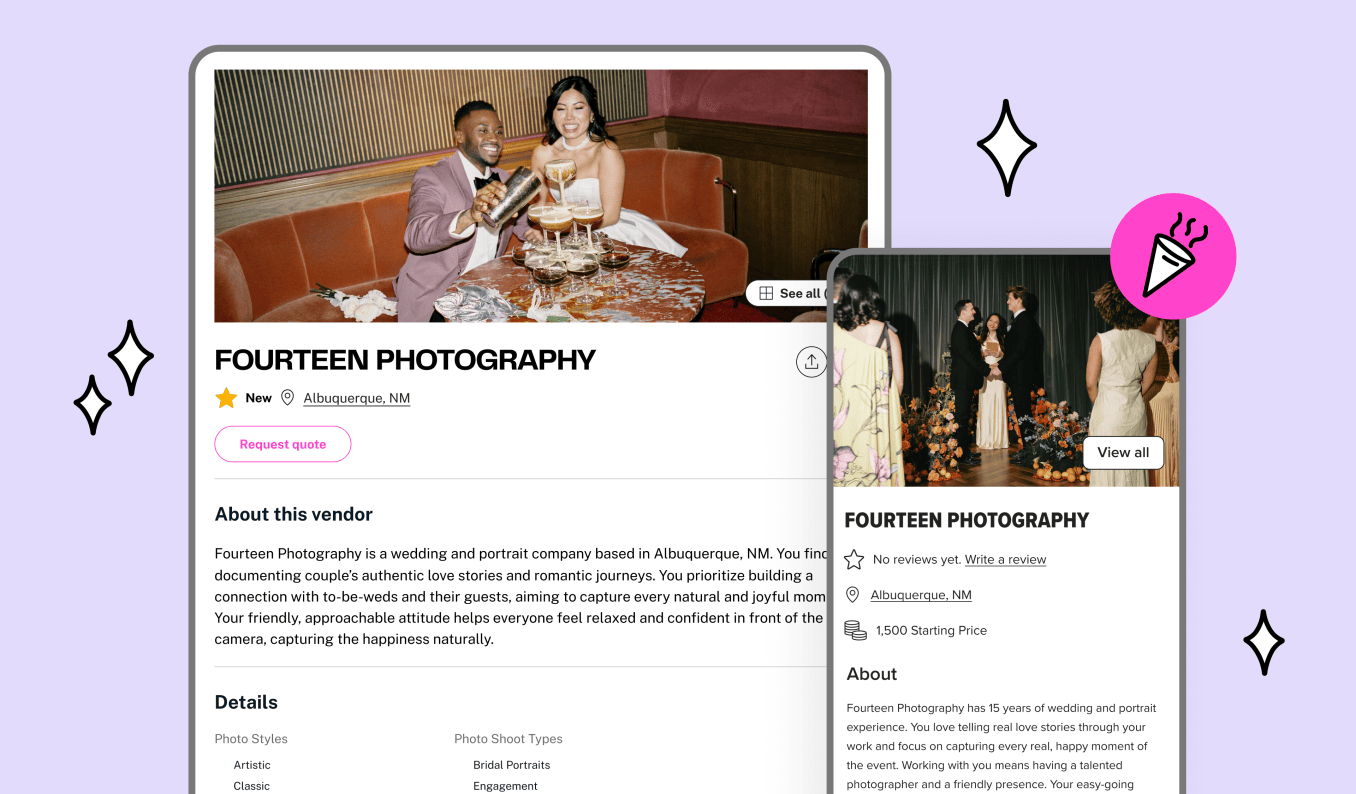
- Structured data: This data is in a standardized format and is added to a website’s HTML to help search engines understand content. For a wedding business, this could include prices, availability, and review ratings. Structured data enables rich snippets, or visually enhanced search results featuring star ratings or images that boost click-through rates (CTR). This is incredibly impactful for wedding businesses, which all tend to have some visual element that lends itself well to AI search results.
- Logical heading hierarchies: These include H1 titles and H2 subheadings in blog posts that help LLMs understand the content structure, extract precise information for summaries and identify which sections contain the most relevant answers. Content with clear, descriptive heading structures—“My Wedding Services,” “My Prices” and “Wedding Couple Reviews,” for instance—is more likely to be featured in AI-generated answers and summaries.
- Concise, informative formatting: To identify the best answers—usually those that are authoritative and relevant—LLMs look for information expressed in the most direct way possible across all searchable online surfaces. “For instance, consider, ‘My photography wedding package includes this,’ instead of just, ‘Packages starting at this,’” Robert explains. This helps increase your chances of appearing in a couple’s search results.
LLM-powered search is also becoming increasingly refined in its handling of more complex questions. Some LLM-powered search experiences, such as Google’s AI Mode, use a process known as “query fan-out.” With this technique, a question is broken into multiple related searches before information from different sources is brought together to generate a response. For wedding pros, this process makes it even more important to provide clear, helpful and thorough information about their business across the web. That way, AI systems can find relevant details wherever they’re searching.
It’s also important for pros to keep in mind that traditional SEO principles, such as expertise and authority, remain fundamental because AI engines prioritize authoritative information and reputable sources, says Taylor.
AI search best practices for wedding pros
There are ways in which pros can increase their chances of showing up in the best way possible in an AI search query based on how LLMs generate answers:
- Pay attention to how you structure and order your words: Since LLMs decide what to return in a search query by analyzing how language appears in a web page, use proper headings, like H1, H2 and H3, bulleted lists, FAQ structures and tables to convey information concisely.
- Write for the humans, not the LLMs: “You want to have the content on the page naturally speak like a human,” Robert said. “Don’t think about writing for an LLM. Don’t assume context.”
- Be consistent: Ensure your brand name and details are consistent across all platforms to improve entity consistency in how LLMs crawl the Internet. This includes your website, social media and Storefront if you have one. “By keeping their marketplace Storefront up-to-date and consistent with their website, pros create a unified brand signal that makes it easier for both traditional search engines and LLMs to understand what a pro truly offers,” Taylor said.
- Create the right sentiment: How people feel about your brand—and how this shows up online—is a critical consideration for LLM visibility. LLMs aggregate signals from across digital surfaces—community forums, social media, and ratings, for example. This is where it’s vital to ensure that elements like couple reviews are incorporated across all channels where your brand appears online.
- Building trust has never been more crucial: In the age of AI, trust is the single most precious commodity for people and bots alike. Aligning with brands that have both trust and authority (think: domain authority, brand awareness, favorable consumer perception) is the easiest way to boost your own credibility. “TheKnot.com is considered a core citation source in prompts related to weddings,” MaryKate said. “Association with our domain is thought to relate to LLMs’ understanding of the wedding space at large.”
Pro tip: Wedding marketplaces like The Knot have strong online authority—which means a vendor listing could help boost your overall awareness in AI search. “A pro’s marketplace Storefront can act as a crucial trust anchor that provides the structured data, such as verified reviews, location details and standardized service lists, that AI models use to verify a business’s legitimacy,” Taylor said.
The main AI search tools
For search engines, Google has long been the market leader. However, AI search involves a range of different tools and platforms that pros must consider when optimizing their overall search strategy to reach high-intent, planning couples. Here are the current major GenAI leaders and their self-reported differentiators:
- ChatGPT: A versatile conversational AI from OpenAI. Couples widely use it for brainstorming and planning, though its “Search” features rely on a mix of its internal training and real-time web browsing.
- Claude: Developed by Anthropic, Claude is known for “Constitutional AI” (a focus on safety and ethics). It excels at processing long documents—like multi-page catering contracts or venue brochures—with high accuracy.
- Google Gemini: Deeply integrated into the Google ecosystem. It is particularly powerful for wedding pros because it pulls directly from Google’s massive knowledge graph, including Google Maps and business listings.
- Grok: xAI’s model (integrated into X, formerly Twitter). It specializes in real-time information and conversational trends, making it a place where “internet-style” buzz and current wedding trends surface quickly.
- Microsoft Copilot: The AI companion embedded in Microsoft 365 (Word, Excel, etc.). It is often the go-to for corporate-leaning planners and pros who use it to summarize emails or organize spreadsheets.
- Perplexity: A dedicated “answer engine” that acts as a hybrid between a chatbot and a search engine. It is unique because it provides clear, numbered citations for every claim, linking directly back to the sources.
All of these tools offer different responses to AI search queries because both the algorithms underpinning their LLMs and their web retrieval processes (how they obtain real-time information) vary. It’s also important to note that LLM responses are not static.
“LLMs are probabilistic and will try to give you the best answer at any given time, driven by a variety of behind-the-scenes factors.”
MaryKate Callahan, Director of Consumer Strategy at The Knot Worldwide
This is the case even if it’s the same query from the same user the next day. “We, like everyone in search marketing, are still learning about what influences these responses,” she said.
That’s because AI answers are constructed based on the best possible response at the time. This makes AI results more fluid than traditional search.
Several factors can shift what that “best” answer looks like from one day to the next. For example, if a user has “stored memory” enabled, the AI might tailor its recommendations to the user’s past wedding-planning conversations. The specific model used also plays a role—many platforms now let users choose between “fast” models for quick brainstorming and “thinking” models for complex logistics.
Pro tip: The Knot is now available within ChatGPT, helping your business get discovered where couples are actively exploring, narrowing their options and making early decisions. Read all about how to use it here.
How wedding pros stay ahead of AI and AI news
AI systems—and the LLMs underpinning them—are still a work in progress. Because the technology is changing so rapidly, there is really no telling what new model, tool or capability will emerge in the months and years to come. What’s essential for pros is to lay the groundwork for showing up in AI search now by optimizing all of their digital properties to align with how LLMs deliver results.
“Your presence on the internet has always mattered, but it’s even more critical now to show up positively across trusted sources online,” MaryKate said. “That visibility drives discoverability and ultimately supports your business.”
To stay visible as AI evolves, pros should keep their business information accurate and consistent across their website, Storefront and any other online profiles. They should ensure their services, location, pricing and contact information are up to date. Collecting genuine couple reviews can also strengthen their online presence and provide helpful social proof for couples. These simple habits can make it easier for LLMs to understand a pro’s services and what makes them the right choice for a couple.
AI search (and AI in general) is a complex, fast-moving space, and it’s a lot for any one business owner or entrepreneur to manage or navigate. That’s why WeddingPro and The Knot Worldwide have a team of AI professionals like Rob and MaryKate thinking about these technologies daily—so we can ensure vendors like you show up where couples are looking for them.
Let's grow your business together!
Start advertising on The Knot and WeddingWire, the top two wedding planning platforms.
What is new!
- Small Steps, Big Impact: Practical Ways to Build Sustainability into Your Wedding Business
- How Millennial and Gen Z Demand Shapes Sustainability in Weddings
- How to Measure Marketing ROI from The Knot and WeddingWire
- Maximize Your Success: How to Make Your WeddingPro Storefront More Shoppable
- The Knot Worldwide Welcomes Zola to our Family of Brands